

Module user guide
Urology
Practical guide to record intake, urination, leakage and accidents.
What can be recorded?
- Intake
- Urination
- Leakage
- Accident
In this guide
1How to record correctly

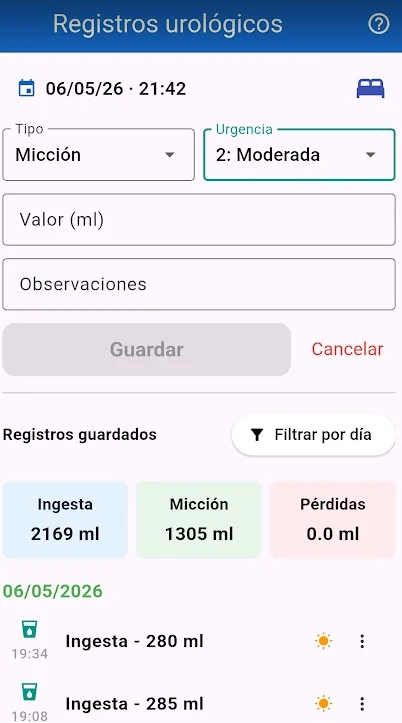
Change date and time
You can change the day or time to add past records. Tap the date and time box to return to the current moment.

Active / sleeping
If you are standing at 3:00, use the sun. If you are in bed, use the bed icon.
This is not day/night, but awake/sleeping.
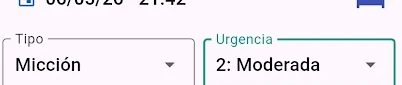
Record type
When selecting a record type, specific options appear: urgency for urination, absorbent type for leakage or accident situation.
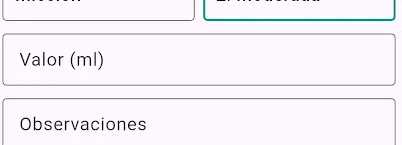
Data validation
Enter values in ml. For leakage, decimals can be used and 0 is valid when there has been no leakage during that period.
When the value is correct, the save button is enabled.
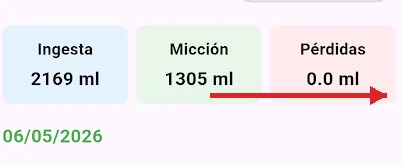
Edit a record
To edit or delete a record, tap the three dots on the right and choose the option.
2Charts
See your progress
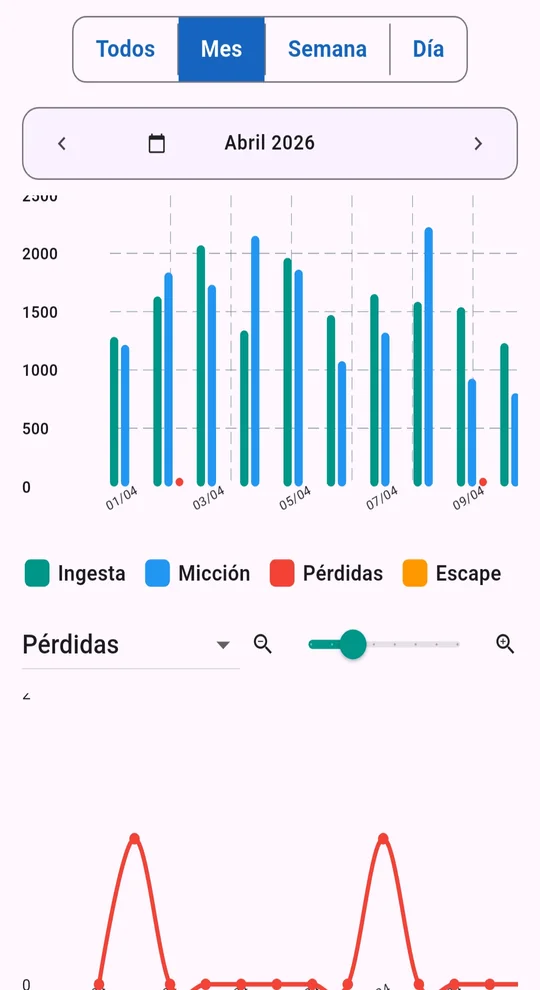
In Charts, choose the period (All, Month, Week or Day) and move between periods with the arrows.
The bar chart shows intake, voiding, leaks and leakage episodes for each day, each in its own colour. Below it you can choose a single type of record, such as leaks, and enlarge it with the zoom control.
The PDF icon in the header exports the charts so you can share them.
3Reports
Daily summary
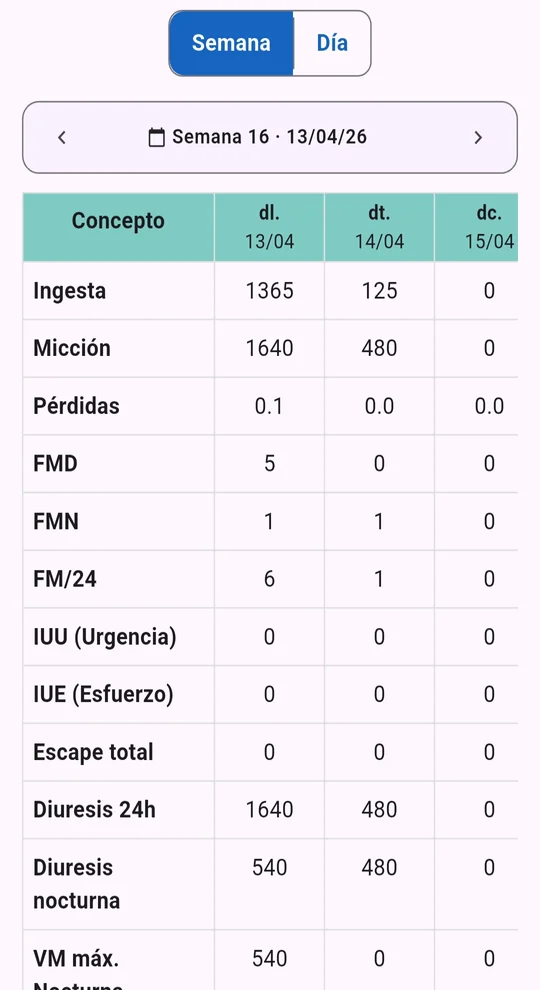
In Reports, choose Week or Day and navigate with the arrows. The table summarises intake, voiding and leaks for each day.
It also calculates indicators useful for your appointment: daytime, night-time and 24-hour voiding frequency (FMD, FMN, FM/24 in the app), urge (IUU) and stress (IUE) incontinence episodes, leakage episodes, 24-hour and night-time urine output, and maximum night-time voided volume.
The PDF icon in the header creates the report so you can review, print or share it.
4Tips for getting started
Measuring container
Use a graduated container. A 250 ml one is usually enough, although sometimes it may need to be filled twice.
Small scale
During the first days, a small 1 kg scale is useful to measure glasses, cups or common containers.
Leakage
To provide useful information to the doctor, record at least the absorbent change when getting up and all necessary changes during the day.
Accident context
When leakage or an accident occurs, note whether it happened while coughing, walking, laughing, making effort or due to urgency.